
What Is In Vivo CAR-T Therapy ?
In vivo CAR-T therapy leverages targeted delivery technologies to deliver CAR-encoding genetic materials, such as mRNA or a viral-vector payload, into T cells in patients, enabling in vivo generation of CAR-T cells without ex vivo cell engineering.
Seven Advantages of In Vivo CAR-T Therapy
More efficient, more accessible and more precise cell therapy - from ex vivo manufacturing to in vivo programming
An Off-the-shelf Therapy
Universal vectors and formulations are ready for immediate use, with no need to wait for cell manufacturing.
Short Treatment Cycle
Ex vivo production is no longer required. CAR-T cells can be rapidly generated in vivo.
Avoids Lymphodepletion-Associated Toxicities
The approach can preserve immune-system integrity and reduce risks of complications, such as infections.
Streamlined CMC
Eliminating ex vivo cell isolation, culture and gene modification can accelerate development and manufacturing.
Advanced cost-effectiveness
A mature CMC platform can substantially reduce manufacturing costs compared with conventional cell therapies.
Manageable Safety Profile
Transient CAR expression through an mRNA-LNP route harnesses better safety, facilitating applications in indications with stringent safety requirements.
Improved Accessibility
Simplified administration and lower manufacturing costs expand patient access to frontier cell therapies.
Our In Vivo CAR-T Pipeline
Grit Bio is among the early movers in China to systematically develop in vivo CAR-T approaches and advance them into investigator-initiated human studies. The Company is also one of the few players in both non-viral and viral-vector delivery routes, positioning the Company at the global frontier of clinical translation in in vivo T-cell engineering.
Grit Bio has established two complementary in vivo CAR-T technology routes: LNP-based delivery, represented by GT801, and lentiviral-vector delivery, represented by GT860.
Leveraging its proprietary capabilities in targeted delivery, payload design and in vivo T-cell engineering, Grit Bio has built an extensible in vivo cell-engineering platform. Rather than being limited to a single candidate, the platform can flexibly match technology routes to different diseases, targets, clinical settings and treatment objectives, enabling continued pipeline expansion and supporting the evolution of cell therapy toward simpler treatment workflows, greater accessibility and scalable use.
GT860
GT860 is a dual CAR in vivo CAR-T candidate, delivered using T-cel-targeted lentiviral vector.
Indications
Multiple myeloma
Platform
TgVec™
GT801
GT801 is a next-generation, mRNA-based anti-CD19 in vivo CAR-T therapy that uses T-cell-targeted LNPs to deliver optimized mRNA.
Indications
Autoimmune diseases
Platform
T‑Cell‑Targeted LNP Delivery
Grit Bio's Dual-Route In Vivo CAR-T Platform
Grit Bio's dual-route in vivo CAR-T platform comprises an LNP-mediated delivery approach, represented by GT801, and a lentiviral vector-based delivery approach, represented by GT860.
Leveraging its proprietary technologies, the company has established a comprehensive in vivo cell-engineering platform designed to enable flexible technology deployment and support continued pipeline expansion.
GT801: mRNA-LNP Product Design
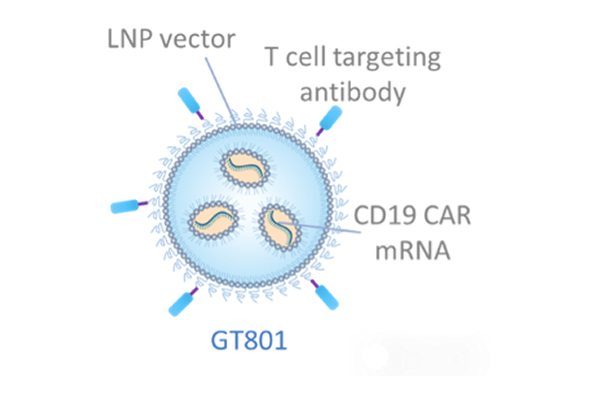
Powered by the T‑Cell‑Targeted LNP Delivery Technology platform, CLAMP technology enables site-specific, controlled conjugation of T-cell-targeting ligands to the LNP surface. The design is intended to improve targeting efficiency, minimize nonspecific uptake and promote efficient CAR expression in T cells.
GT860: Targeted Lentiviral Product Design
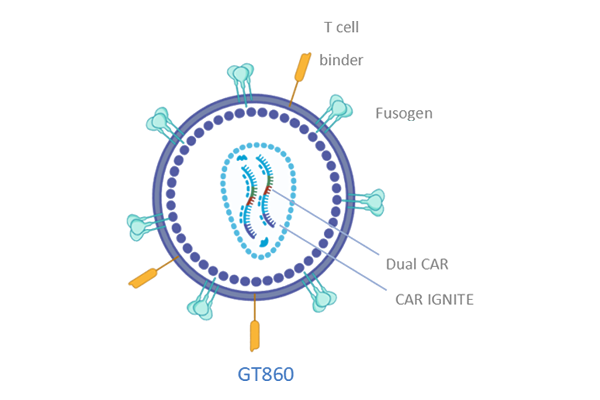
By mutated VSV-G fusogen and optimized T cell binder, GT860 can target T cells accurately and improve T cell transfection efficiency.